2025 State of the University address
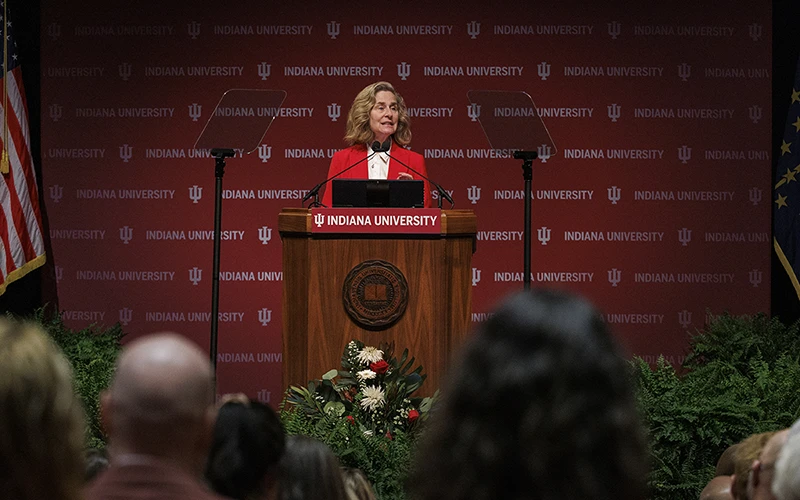
State of the University address
Thank you, Susan (Popham). I am grateful to you and your University Faculty Council co-chairs Bill Ramos and Phil Goff for your dedicated service. As a longtime faculty member who values our tradition of shared governance, I deeply respect the commitment each UFC member brings to this work. From shaping new policy frameworks to adapting to new state legislation and exploring enhanced commitments to free speech, and more, I’m grateful for what we continue to accomplish together. Your efforts this year reflect our collective belief that collaboration is essential, and that only through a united community can we strengthen an institution as dynamic and far-reaching as Indiana University.
I am pleased to welcome members of the Indiana University Board of Trustees who have joined us this morning. Please join me in welcoming Dr. David Hormuth, chair of the board, and Isaac White, our student trustee.
Also joining us today are members of the University Cabinet, including our two newest members – Kendra Ketchum, Vice President for Information Technology and Chief Information Officer, and Josh Mackey, Vice President and Chief Human Resources Officer.
And finally, welcome to the faculty and staff members, students, colleagues, and community leaders who have joined us for the 2025 State of the University address.
A university moving as fast as the world it serves
When I arrived at Indiana University in 2021, I knew this place was special. Nearly five years later, I can say with certainty: IU is the most remarkable university in the nation. We overcome challenges. We attract investment through gifts and partnerships. We welcome exceptional students. And together, we create change that shapes a better tomorrow.
We’ve embraced the notion that the best universities never stand still. They consistently reflect on how to improve—setting the highest of standards for themselves—from serving students to producing the greatest impact through their research to strengthening the future of their state.
And they fulfill the universal purpose of great universities: preparing the next generation to work, to lead, and to make an impact.
At Indiana University, we fulfill this mission at a scale and with a level of collaboration few universities can rival, because our nine campuses stand united under one banner to solidify our place as the engine of Indiana’s growth.
And because we do this so well, Indiana University engenders a pride unlike anything I’ve seen anywhere else. Whether you’re in an airport, a café, a classroom, or your local gym, you’ll find someone in IU crimson, eager to share what this university means to them and how their IU experience shaped their lives.
That pride is built by our exceptional faculty, by the experiences students have across our campuses, by academic excellence across disciplines—from the arts to business, sciences, and engineering—by our nationally ranked athletics, and by the partnerships that fuel research and launch careers.
It is strengthened further by the largest living alumni base in the country—806,000 strong. That’s more than a statistic. It’s a network of people who share a bond, who open doors, who invest in their communities, and who want the next generation of IU graduates to have the same life-changing opportunities they did.
The IU 2030 strategic plan
IU 2030 is our roadmap—clarifying what we must do today to reach the future we imagine. I’m deeply proud of all we’ve achieved, and more energized than ever by where we are headed. Today, I’ll walk through each of the three pillars of our IU 2030 plan, outlining our progress so far that proves we are on the right path. I’ll also outline the future we are building.
As we do that, it’s important to note that preparing students to lead requires more than skills—it requires the confidence to engage openly with different perspectives. That’s why the free exchange of ideas matters so deeply at Indiana University. Free speech and freedom of expression are essential to developing a dynamic, respectful, and workforce-ready generation—and to powering discovery that earnestly seeks truth.
And in the spirit of engaging with a diverse array of voices, throughout this address, you’ll hear from voices across our community—a student, a faculty member, and an industry partner—offering a glimpse into the reach of this university and the responsibility we share to serve all.
What makes Indiana University unique is its unmatched breadth and its ability to harness the power of excellence—wherever it exists across IU campuses—to drive innovation, foster collaboration, and create opportunities.
The collective strengths of our nine campuses, all united as one university, make IU stand apart from our peers—and make us far greater than the sum of the university’s individual parts. We are one connected university—“One IU” with the scope and scale to serve every corner of the state and beyond.
The momentum of IU 2030 is focusing this collective strength toward a single, unified vision. The success of our “One IU” vision is the first and most crucial piece of evidence that our strategy is working.
How do we know?
We see it in the flagship excellence at IU Bloomington, where record enrollment and application growth of nearly 60% since 2021 prove that our reputation for excellence is resonating nationally.
We see it at IU Indianapolis, a campus that is thriving in its second year under its new identity and solidifying its place among the nation’s top-tier research universities as our second R1 campus.
We see it in our School of Medicine, the nation’s largest, which ranks 13th among public medical schools in the country in terms of funding from the National Institutes of Health and serves as the very bedrock of healthcare in Indiana.
We see it in our regional campuses—the true heartbeat of "One IU"—which ensure every single Hoosier has a pathway to opportunity.
We see it in IU Online, which provides vital flexibility in high-quality education to our state's workforce, and where enrollment has exceeded 10,000 students and graduation rates are higher than comparable online programs.
Perhaps most importantly, we see it in the growing body of work that crosses campuses. In the academic programs that span multiple campuses. In the research collaborations that unite faculty from multiple schools. And with partnerships that increasingly seek collaboration not just with one campus, but with the entire university.
Without question, each IU campus is exceptional—defined by its own distinct character. But together, as One IU, we are something even greater—a university unequaled in its ability to educate, innovate, and serve.
We rightfully celebrate this excellence, but we cannot allow ourselves to be satisfied with it.
We should take pride in our historic strengths—from languages and the humanities to business and music—that made IU one of the most impactful universities of the 20th century. And we must also embrace what’s necessary—making the bold choices needed to focus our work on the areas of strongest demand, greatest opportunity, and clearest connection to student success.
Put simply: We believe Indiana University is too capable and too good not to become even better.
Strength comes from strategy. Progress comes from purpose. And we are simply too good to stand still. Our future requires that we continue to look beyond what has been and focus on what must be to serve our students and our state even more powerfully.
I believe we can represent the next great model for leading public research universities—one that is comprehensive, nimble, and freed from the limits of historic siloes, and unquestionably focused on our impact—for students, in our research and creative pursuits, and for our state. And if that is our goal, then “too good not to become even better” must be our calling card.
Student success and opportunity
Our path always starts with students. That’s why the first pillar of IU 2030 is simple and urgent: Enhancing Student Success and Opportunity. This pillar is about action—real improvements happening now to support the students who are here today and those who will join us tomorrow.
For our students, being too good not to become even better means pressing further to drive affordability. It means simplifying and streamlining the systems that serve and support students – from advising to general education requirements. And it means relentlessly creating, expanding, and evolving academic programs and experiential opportunities that meet the needs of today’s students, while also preparing them to think critically, solve complex problems, and engage as active citizens in their communities.
In this transformational moment for society—where technology like AI must be harnessed alongside the creativity, judgment, and empathy that make us human—I firmly believe that IU can become the model that shows others the way forward.
As I said, at the center of all this is affordability. We are committed to ensuring that an Indiana University education remains within reach—so every student, regardless of background, can access the opportunities they deserve.
The evidence that we are fulfilling that commitment is abundant.
First, we have held in-state tuition flat, cut mandatory fees to save students millions, increased graduate stipends, and raised a near-record $109 million in philanthropic support for student financial aid. We can all take pride that 55% of IU undergraduates now graduate with zero student loan debt. Our efforts to preserve and enhance affordability are central to our public mission. Talent is everywhere in Indiana; opportunity must be, too.
At IU, we pair affordability with opportunity, because the true measure of value is whether a degree changes lives.
That’s why we are also expanding high-impact, hands-on learning at a pace and scale that sets us apart.
IU is the #1 university in the state for study abroad and #4 in the nation, giving our students a global perspective that few institutions can match. And we’re pairing that global reach with innovative workplace experiences here at home—like the Eli Lilly and Kelley Indianapolis Business Plus co-ops—programs that place students directly inside leading employers and prepare them to step confidently into the workforce on day one.
And in the summer of 2026, we will open our Capital Campus in Washington, D.C.—a dynamic extension of IU in the heart of our nation’s capital. This presence will give our students unparalleled opportunities to develop as civic leaders and to engage with leading professionals in technology, business, media, law, the arts, and many other fields.
Let’s see what experiential learning looks like in practice.
Brittany Crabtree is a senior at IU Indianapolis in the O'Neill School of Public and Environmental Affairs, with a double major in Criminal Justice and Public Safety Management. She's in the Honors College and the Accelerated Master's Program, but most importantly, she has completed critical internships with FEMA, Marion County Emergency Management, and the Indiana State Fair. Let’s hear from her about how those internships helped bridge her academic studies with her passion for helping others.
Voiceover text from video of Brittany Crabtree, Senior at IU Indianapolis:
I did an internship with Marion County Emergency Management. On my first day, my boss was walking me around the Emergency Operations Center, and a lot of the things she was talking about, she was explaining to me what it meant, and I was like, ‘wow, this is stuff I learned in school.’ Emergency support functions—I know what those are.
I know what the signs of the emergency management cycle are, and all that stuff really connected, like stuff I was learning in my classroom to this experience. I was like, ‘wow, this is where I’m meant to be.’ I understand this topic, and everything she was saying, I was like, oh, I already know what all that means.
I feel really excited to be able to get out into the emergency management field. I’m always so eager to be able to give back to my community. I’ve seen the impact of what disasters can do on individuals firsthand, and so I’m really excited to get out there and help them make a difference, even though they might be facing the worst day of their life. I want to be there to be able to support them.
Brittany represents nearly 90,000 IU students across our campuses and online programs. Together, they embody the promise of a new generation. We are redefining student success for a new era—one that prepares every Hoosier to lead with purpose, serve with distinction, and shape a brighter future for all.
We are doing this, in part, by successfully implementing new university-wide systems that replace fragmented processes and legacy systems with a unified, student-centered experience.
Our new platforms for registration, degree tracking, and admissions are now live, leveraging technology to simplify the student experience from application to graduation. These tools are designed to enhance retention and boost on-time graduation rates, ensuring that students who choose to start their college experience at IU can finish at IU. One exciting example of this capability is our predictive advising enhancements driven by AI. By utilizing predictive models to identify at-risk students, advisors can now proactively intervene to lower dropout rates and keep students on track for graduation. The impact is immediate: this fall, early advising participation rose by 13 percentage points overall, and 62% of these students successfully met with an advisor, effectively closing critical engagement gaps.
We are also investing in a series of high-demand academic degree programs to complement our new research institutes at IU Indianapolis and areas of life sciences excellence in Bloomington, offering new opportunities for students.
At IU Indianapolis, we have new degrees in biomedical sciences, the business of biotechnology, biomedical engineering, and biochemistry.
At IU Bloomington – building on our legacy of excellence in the arts, humanities and social sciences – we are propelling human-centered engineering into a new era with a $75 million investment that will support new, cutting-edge academic programs, expert faculty, and state-of-the-art facilities dedicated to these increasingly critical fields. The Luddy School of Informatics, Computing, and Engineering will launch new degree programs in emerging areas, including computer engineering, robotics, bioengineering, nanoengineering, microelectronics, and electrical engineering. These new academic programs will be offered in addition to the existing degrees in intelligent systems engineering, with some launching as early as next year. If our Big Ten football program has taught us anything, it’s that we can excel at building new strengths. Indiana University is now home to emerging football and engineering powerhouses.
Campus leaders are also working with faculty to reimagine, standardize, and simplify our General Education curriculum, because we are not just preparing students for a first job, but for a lifetime of adaptability and impact.
We are also building an AI-forward university. By extending our highly successful Gen AI 101 course to students and the 806,000 alumni who comprise the nation’s largest alumni community, we are ensuring the IU degree remains a competitive asset in an evolving economy. The future belongs to those who combine what makes us human with the tools reshaping our world. Together, these actions show the power of a great university choosing to become even better. IU is embracing change with clarity and strategy—becoming more nimble, more resourceful, and more aligned with the needs of our students and our state. This is how we honor our mission. And this is how we lead.
Our focus on students is paralleled by our commitment to research. This brings us to the second pillar of our IU 2030 plan.
Transformational research and creativity
For our research mission, being too good not to become even better means rising to meet this transformational moment. It means investing in faculty even as others pull back. It means creating the conditions where brilliant faculty can move faster, collaborate more deeply, and pursue discoveries that answer the most urgent challenges of our time. And it means reimagining long-standing practices so that Indiana University becomes not just a participant in the future of research—but a force that defines it.
The evidence of our momentum is clear.
Driven by the brilliance of our faculty researchers, we have reached a historic milestone: One billion dollars in annual research expenditures—a 34% increase since 2021. Crossing the $1 billion annual research mark signals not just scale, but impact—research that translates into cures, companies, and community growth. This achievement is tangible proof that partners, funders, and industry are also invested and helping bring IU 2030 to life.
To sustain this, we are investing over $250 million to solidify Indiana as a global leader in life sciences. The momentum we've built in just two years since announcing the investment is remarkable. And our own investments—and those of our partners—are coming to life.
Supported by a $60 million state investment, construction is underway for the new STEM Lab Building at IU Indianapolis, an addition to our existing Science and Engineering Lab. Expected to be completed by Fall 2026, it will feature state-of-the-art spaces, including a 3D bioprinter lab and an advanced physics lab. This new facility will support the development of advanced biomedical sensors for diagnostic and health monitoring purposes. It will also house our two new interdisciplinary research institutes—the Convergent Bioscience and Technology Institute and the Institute for Human Health and Wellbeing—and will anchor the IU Science and Technology Corridor.
The IU School of Medicine’s new 11-story, 326,000-square-foot Medical Education and Research Building, or the “MERB,” was made possible in large part by a generous gift of $145 million from IU Health. The building is a state-of-the-art facility for educating the next generation of physicians and a hub of research excellence. In addition to the MERB, the site will eventually include the new IU Health downtown hospital and plans for an Indy Health District focused on creating healthier communities in the surrounding neighborhoods.
We are funding $23.1 million in renovations to laboratories and research facilities for faculty at IU Bloomington and providing an additional $7.5 million from IU Research to support life sciences research initiatives on the Bloomington campus.
Earlier this fall, we broke ground for the new home of the Indiana University Launch Accelerator for Biosciences, or IU LAB, at the 16 Tech Innovation District, supported by a $138 million grant from Indiana’s Lilly Endowment. IU LAB is where academia meets industry to move ideas from concept to impact, where collaboration across biosciences, technology, and artificial intelligence accelerates innovation and strengthens our community, and where a new generation of talent is forged through cutting-edge degree programs and industry-focused credentials. With David Rosenberg, former Indiana Secretary of Commerce, serving as the inaugural president and CEO, IU LAB further demonstrates the university's ability to attract exceptional leadership. The new IU LAB facility will feature five interconnected spaces designed to foster collaboration and innovation across disciplines: an Academic Gateway, a Futures Center, a Bio-Start-up Center, a Public-Private Partnerships Center, and the Joint Center of Excellence for Point-of-Care Precision Medicine. Together, these centers will create dynamic opportunities for IU students, researchers, entrepreneurs, and industry leaders to drive discovery, accelerate commercialization, and shape the future of human health. Of course, we aren’t waiting for the building’s opening in 2027 to make progress. IU LAB is already mobilizing Indiana’s biosciences ecosystem, building partnerships, launching programs, and laying the foundation for long-term innovation.
While the momentum of our research enterprise is undeniable, it is also where we feel the steep climb. We've exceeded $1 billion in R&D expenditures as a university. But our work isn’t done: By setting and meeting high standards for our faculty, while continuing to invest in our faculty and the facilities they need to pursue knowledge and truth—I believe IU Bloomington can, and will, make a dramatic climb to the top third of the Big Ten in research productivity.
To get there, we must change how we do things and continue to make bold choices, charting the path we need for the next decade—even if that means reimagining longstanding practices to build on longstanding strengths and create new ones.
We recognize that attracting world-class faculty is the single most crucial factor in driving research excellence. That’s why we’re investing our resources in common research themes, such as life sciences, biosciences, technology, and human health.
We are investing $47.4 million over five years at IU Bloomington to recruit new faculty members in these fields as part of the Faculty 100 Hiring Initiative. In addition, we’re investing $46.1 million in faculty startup costs to support new faculty members in accelerating innovative and interdisciplinary health science research, increasing academic and industry partnerships, and expanding federal grants and contracts as part of this initiative. We have so far hired outstanding faculty members in cybersecurity, microelectronics, applied quantum information science, physics, biology, intelligent systems engineering, and other disciplines.
I recently hosted a reception for our Faculty 100 hires, and they are all truly remarkable. I wish I could introduce you to all of them, but let’s hear from one of them. Samantha Harvey is a new assistant professor in the Department of Chemistry in the College of Arts and Sciences. Returning to the campus where she earned her bachelor's in chemistry, she brings experience from her doctoral studies at Northwestern, where she was a National Science Foundation Graduate Research Fellow, and her postdoctoral work at the University of Washington. Her research is highly interdisciplinary, involving subjects such as chemistry, materials science, physics, and engineering. Her work is a perfect example of the high-impact research we are prioritizing. Here's what she has to say about the long-term significance of this investment.
Voiceover text from video of Samantha Harvey, Assistant professor, Indiana University:
What excites me the most is that we get to come in as a large cohort, and we get to focus on specific areas that they were really trying to enhance in IU's research community.
Putting people into these positions, investing in our research groups, is thinking about the fact that we are here for the long haul. We're here to do research, to make innovations, and to do so over the course of years.
It's not just about hiring right now. It's about making an investment in the future of IU.
Professor Harvey’s work, and that of her Faculty 100 colleagues, is a powerful example of how we are strategically building on our research strengths at IU Bloomington and across all of our campuses. This is in addition to programs like our Presidential Arts and Humanities Fellows, which accelerates and amplifies the work of outstanding Indiana University faculty poised to become national and international leaders in their fields.
All of this reflects a simple truth: IU’s research mission is already strong—and we are choosing to make it stronger. By aligning resources, reimagining long-standing practices, and empowering faculty excellence across every campus, we are becoming exactly what Indiana needs: a nimble, innovative, purpose-driven research engine.
Finally, our path is not one we walk alone. It is a path of service to our state.
Service to the state and beyond
Providing even better service to our state means showing up for Hoosiers — in every county, every community, and every sector. It means building relationships rooted in trust, listening, and shared purpose. And it means using our strengths in research, teaching, and innovation to help communities solve real problems and create new possibilities. This pillar is about honoring our responsibility as Indiana’s university and deepening the connections that allow our state to thrive.
We promised a deeper partnership with Indiana, and the impact—the proof—is now tangible.
We see it in external partnerships that have grown by more than 13 percent since 2023—from 8,900 to more than 10,000 aimed at meeting Indiana’s workforce needs.
We see it in vibrant Hoosier communities across the state that partner with IU Bloomington’s Center for Rural Engagement, IU Northwest’s Center for Urban and Regional Excellence, and the community-engaged scholars of IU Indianapolis. We see it in the numerous people and groups across the state collaborating with our regional campuses to drive economic development and enhance quality of life. Whether it is addressing health disparities, supporting small businesses, or enriching the arts, IU is present, active, and dedicated to lifting up every corner of our state.
In Bloomington, supported by a $16 million Lilly Endowment College and Community Collaboration grant, we are partnering with the city to accelerate the development of the Trades District into a thriving hub for innovation, economic growth, and community engagement. Our strategic focus is clear: to incubate local entrepreneurs, attract high-wage technology jobs that keep our best talent in Indiana, and enrich the community with new cultural programming and arts pathways.
We also announced a landmark development earlier this fall that perfectly embodies our commitment to strategic collaboration: a Master Collaboration Agreement with Cook Medical. This five-year agreement is the first of its kind for IU, designed as an all-services model that brings together the research expertise and resources of all nine IU campuses with one of the state’s largest employers. This partnership encompasses far more than just R&D. It covers a comprehensive range of services, including workforce training, technical certifications, credentialing, and technical consulting. By proactively addressing and pre-negotiating common stumbling blocks, the agreement allows us to quickly transform cutting-edge research and training into innovations that benefit the classroom, the workplace, and ultimately, patient care in Indiana and beyond.
Just last week, we announced another monumental step: a five-year, $40 million research agreement with Eli Lilly and Company—the largest single industry-sponsored research agreement in the history of Indiana University—to build a best-in-class clinical trial innovation ecosystem right here in Indiana. This massive initiative leverages IU’s clinical and research expertise in conjunction with Lilly's global leadership, with an initial focus on neurology and oncology. Its goal is threefold: to design smarter, AI-enabled clinical studies, to accelerate access to resources for complex conditions such as Alzheimer’s disease across Indiana, and, critically, to cultivate a pipeline of skilled, diverse, job-ready talent for the state’s life sciences sector. This agreement, led by IU LAB, marks a new chapter in how we work with our industry partners. It is proof that the old way of doing things, where universities and industries stayed in separate lanes, is a thing of the past.
In our future-oriented model for great public research universities, which we are building together, IU is not a silo, it is a catalyst. It moves with speed. It breaks down barriers. And it delivers results that change lives.
Let’s hear from David Ricks, Chairman and CEO of Eli Lilly and Company, about what this new partnership means for the future of Indiana's medical research and healthcare ecosystems.
Voiceover text from video of Dave Ricks, Chairman and CEO of Eli Lilly and Company:
We're excited to partner with IU to expand access to clinical trials in the state.
And clinical trials are unique because they really bridge the laboratory experiment, like, developed in the lab we’re in now, to actually being common practice.
So, we have to develop the evidence, the data that the medicine's actually doing what it's supposed to be doing. And we do that via clinical trials. Without that step, we can't develop that information, and there would be no new medicines.
So, this is a critical step in our business and in the drug research business. But it's also important to do it in the real-world setting, like our state, with a diverse population in rural and urban settings.
And this is a big step forward. It can help advance and speed up new treatments and cures but also expand access to great care for people in Indiana.
When industry leaders like Lilly and Cook Medical invest heavily in Indiana University, it is a clear validation of the talent and potential that reside in our faculty and our students. We are leveraging this powerful industry momentum to serve the state through something equally critical: building a true, university-wide entrepreneurial ecosystem.
In the past, our innovation efforts were fragmented. Today, we have built the connective tissue to empower innovation at every level.
Our first step was the 2023 launch of IU Innovates, our university-wide initiative to help student and faculty entrepreneurs turn their bold ideas into viable ventures. Today, IU Innovates is the front door to entrepreneurship at IU, reaching across every campus and every school. Julie Heath, the architect of Indiana’s first entrepreneurship ecosystem strategy, serves as the inaugural executive director of IU Innovates. The demand for its services has exceeded all expectations. We have doubled IU Innovates’ office space in Bloomington, opened new space at IU South Bend, are launching an office in Indianapolis, and are actively serving all campuses. It is the connective tissue we needed, ensuring that a great idea born anywhere at IU has a clear path to impact.
Another key component of this initiative is the IU Health Incubator at IU LAB, which was established earlier this year with a $1.5 million annual sponsorship from IU Health. This incubator has two distinct components: a pre-accelerator that nurtures early-stage ideas from faculty and students, and the LifeTech Accelerator, which provides intensive support for more mature companies poised for growth. Powered by gener8tor, its pre-accelerator hosted the first cohort of five founders this summer, providing them with tailored support designed specifically for entrepreneurs. The Life Tech Accelerator, powered by Plug and Play and the Central Indiana Corporate Partnership, is now working with 12 startups that are tackling some of healthcare’s biggest challenges, developing new therapeutics, diagnostics, and medical devices to drive innovation in Indiana. One of them, OsseoLabs, is at the forefront of revolutionizing surgical procedures through the integration of cutting-edge 3D printing technology and artificial intelligence. Its CEO and co-founder, Vikram Ahuja, is an IU alumnus and a visiting professor in Bloomington’s Kelley School of Business. The IU Health Incubator at IU LAB will help up to 40 human health biotech startups per year grow into major companies.
The final, essential component is our commitment to igniting and empowering our world-class faculty and researchers. In addition to the support I described earlier, our IU Innovation and Commercialization Office collaborates closely with faculty, industry, and the entrepreneurial community to bring innovations stemming from IU’s research to the marketplace, where they can create lasting social and economic impact.
Everything I have just described is a critical part of our effort to build an entrepreneurial ecosystem. It is where ideas become action—a community where students, faculty, alumni, and partners come together to solve problems, launch ventures, and build a better future for Indiana.
Together, our work across this pillar shows what it means for Indiana University to choose to become even better. By working with speed, purpose, and a spirit of true collaboration, we are redefining what a university can contribute to its state. IU is proving that when we align our strengths with Indiana’s needs, we become not just a partner—but a catalyst for innovation, economic vitality, and shared prosperity across our state.
Conclusion
What you have heard today is not just a plan. It is a solemn promise. It is a promise that Indiana University will be fearless in our pursuit of the extraordinary, leading with boldness, innovation, and an unshakeable sense of purpose.
We rise to meet this moment because the "Why" that drives us is undeniable. We do this for the first-generation student from Gary, charting a new course; for the faculty researcher in Indianapolis, pushing the boundaries of science; for the talented visual and performing artists in Bloomington, inspiring our souls; and for the entrepreneur in South Bend, building the economy of tomorrow.
The evidence is clear—from record applications to a billion-dollar research enterprise and expanding partnerships—we are not just on the right path, but we are surging forward.
Change is never easy. But we chose to embrace it because we knew that the path of comfort and familiar practices, programs, and partners offers no actual progress, no lasting impact, and fails to serve the public good. We stopped settling for the status quo and started building a new model for leadership among the great public research universities.
We know the path ahead is steep. But we will continue to make the bold choices necessary to climb it, because we are doing so for the future of Indiana.
If Saturday’s Big Ten Football Championship win and newly crowned #1 national ranking proves anything, it’s that a meteoric rise is possible when long-term vision meets relentless effort. What we’re seeing in football is the same transformational progress taking shape across IU. Our strategy is working, and it’s delivering results in every corner of the university.
We are one IU. And as one IU, our potential impact is limitless.
Thank you.
More about the State of the University
Read more about and watch the broadcast from the State of the University address.
-
IU 2030
See the IU 2030 Progress Viewbook December update
-
Watch the broadcast
View the address here.